

Ohio Built the Engine. The O.H.I.O. Fund Intends to Keep It From Rusting
Ohio didn’t stop at inventing flight. It launched it to the Moon. Now it’s building the engine that funds the next 250 years.
The Physics
The flywheel is 5,000 years old.
Potters in ancient China and Mesopotamia used them to smooth the wheel's rotation. Steam engineers in the 1780s used them to convert the violent pulse of a piston into something a factory could use. The physics never changed: store kinetic energy in a spinning rotor, reduce the friction that bleeds it away, and the system sustains itself.
For five millennia, nobody looked at a flywheel and saw a flying machine.
Then two brothers from a bicycle shop on West Third Street in Dayton, Ohio, decided the rules of the previous 5,000 years were a starting point, not a ceiling. They didn't have engineering degrees. They didn't have government contracts. They had a workbench, a theory, and a conviction that human flight was not a matter of if but of precision. They questioned every requirement. They deleted the ones that didn't serve the outcome. And on December 17, 1903, they put a flywheel in the air and called it an airplane. That flywheel, a 20-pound cast-iron component built to smooth the engine's power strokes, produced 90 pounds of thrust. Enough to change everything.
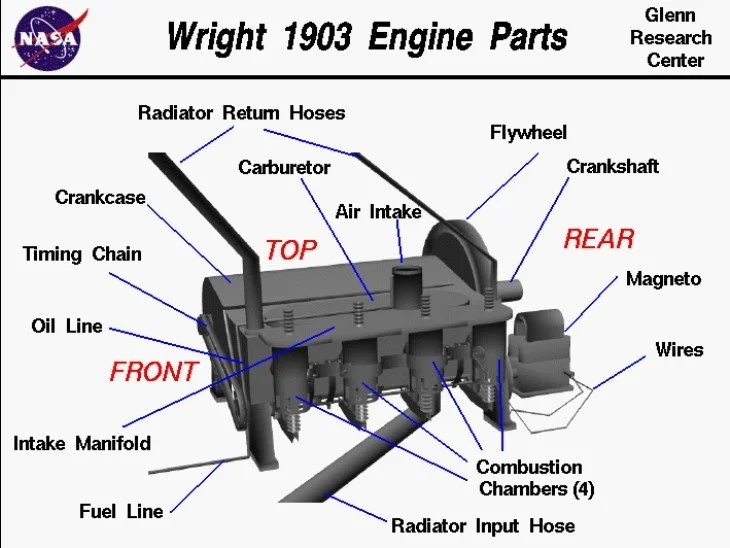
Forty years later, GE Aviation engineers in Cincinnati didn't take the flywheel and spin it faster. They took what the flywheel proved: that Ohio could apply precision to a physics principle and produce something the world had never seen. The result was a jet engine generating over 20,000 pounds of thrust. The same state. The same discipline. Two hundred times the force. A 5,000-year-old idea, compounded in Ohio, launched into the sky again.
Then, on July 20, 1969, Neil Armstrong stepped off a ladder onto the Moon's surface. In his pocket: a swatch of muslin from the wing of the original Wright Flyer, and a piece of its propeller. A statement. Proof that Ohio's legacy was too big for this planet to contain. A proud Ohioan made that point certain.
A flywheel that had been spinning since 1903, storing the energy of every builder, every engineer, every founder who added momentum to the rotor and trusted the system to hold it, reached the Moon in a spacesuit pocket.
The physics are simple. Store kinetic energy in a spinning rotor. Release it on demand. Sustain it by reducing friction. Ohio has been doing exactly that with human ambition for nearly every one of America's 250 years.
The question this article asks is whether the leaders making decisions right now understand what keeps the wheel spinning, and what caused it to seize in past decades.
Like Ohio's aviation story, Peeyush Shrivastava is another proof of concept worth studying.
The Three Conditions
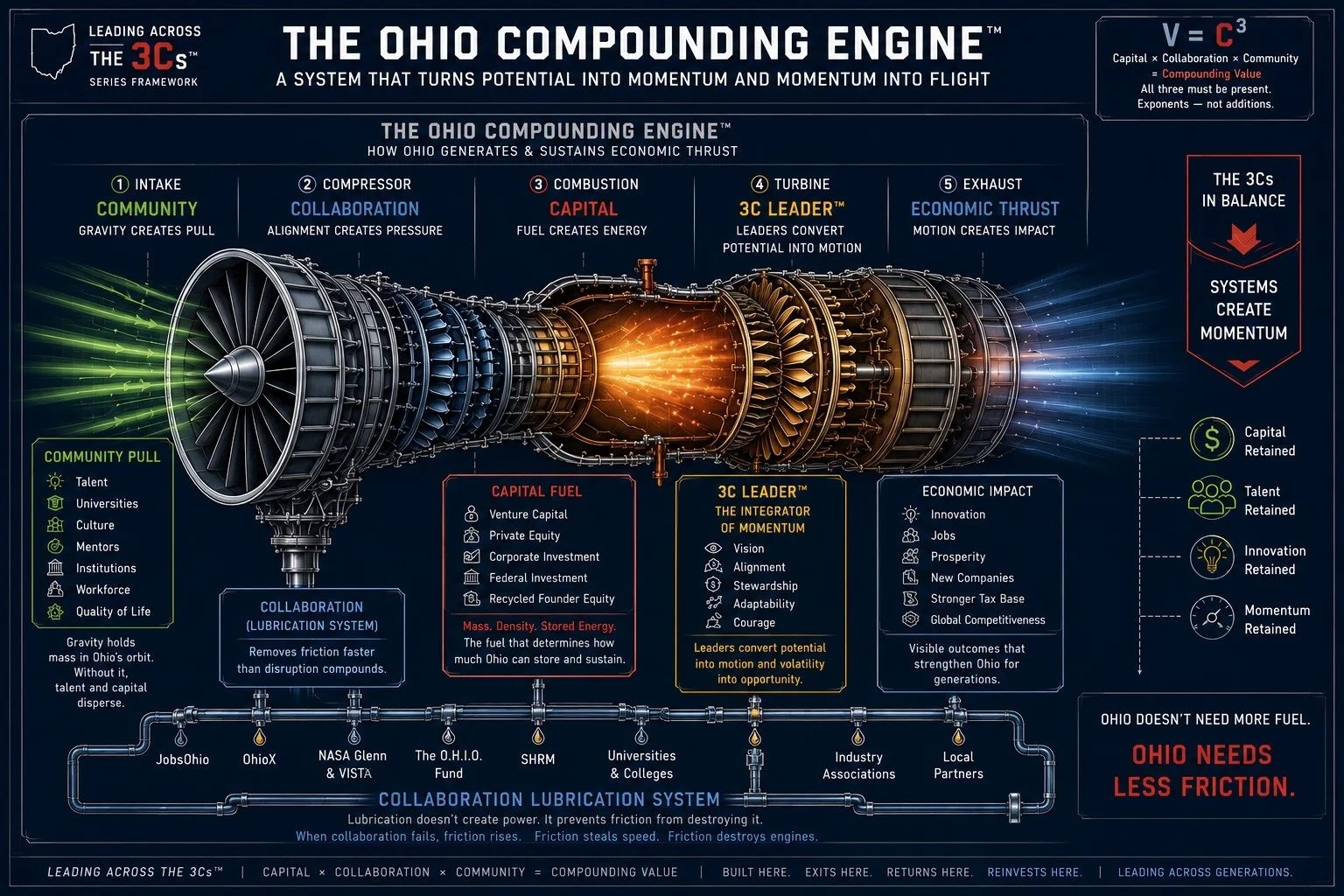
A jet engine doesn’t sustain itself on rotational force alone. Three conditions must hold simultaneously.
The fuel must be dense enough to sustain combustion. The intake must continuously draw air inward to prevent dispersal. And the tolerances between moving parts must be precise enough that the system doesn’t tear itself apart under load.
Pull any one, and the engine fails.
That is also the physics of Ohio’s capital economy. Capital is the mass: the fuel density that determines how much energy the system can store and sustain. Community is the gravity: the intake force that draws mass inward and holds it in Ohio’s orbit rather than letting it disperse to coasts where the pull feels stronger. Collaboration is the lubricant: the precision tolerance that lets Capital and Community operate at full speed without converting momentum into heat.
Ohio has been generating all three for two centuries. The Wright Brothers had them. The GE Aviation engineers in Cincinnati had them. The industrial workforce that built America's manufacturing backbone had them.
The problem has never been the rotor. It has been what happens after ignition.
Capital built here leaves here. Founders who exit relocate. Talent pipelines drain toward coasts where the ecosystem announces itself. The engine spins up and then flames out, decade after decade, not from lack of fuel but from friction that quietly compounds until critical failure is reached and sustained flight is lost.
The Engine Mapped
Capital: The Mass. A denser rotor holds more energy and resists deceleration. Capital is what gives the flywheel its capacity: the weight of invested dollars, deployed talent, and built infrastructure that determines how much Ohio can store and sustain.
Community: The Gravity. Mass alone does not make a flywheel. Something must pull it inward, hold it in orbit, prevent dispersal. Community is that gravitational force: the institutions, relationships, and shared investment that keep capital from drifting to coasts where the atmosphere is louder.
Collaboration: The Lubricant. Gravity concentrates mass. Lubricant lets it move. Without it, friction converts momentum into heat, and the wheel never reaches full speed, regardless of how much mass it carries or how strong the gravitational pull. Collaboration doesn’t generate force. It removes the resistance that causes the engine to corrode.
The Friction Problem. The perception gap. Out-of-state capital extraction. The talent that leaves because the community’s gravitational pull isn’t visible until you already know to look for it.
Full Rotation. The flywheel that no longer requires external restart: Capital dense enough to sustain momentum, Community strong enough to hold it here, Collaboration smooth enough to let it compound.
The 3C Engine
The 3C Engine
The Warning the Rust Belt Left Behind
Before Peeyush Shrivastava’s story begins, Ohio’s most important lesson deserves its due.
The Rust Belt is usually told as a political story. NAFTA. Foreign competition. Corporate betrayal. Depending on who is telling it, the villain changes. But the research refuses to settle on any single cause, and that refusal is itself the most important finding.
Economists studying the decline agree on one thing: it was gradual, structural, and well underway before any single trade deal or technological shift could account for it. Ohio’s core manufacturing jobs in rubber, automotive, and steel began cracking in the mid-1970s, a full decade before NAFTA was even proposed. A single external force didn’t disrupt the engine. It seized from within.
Labor market conflict: the collapse of collaboration between business, workers, and institutions accounts for half of the Rust Belt’s decline in manufacturing employment share. Foreign competition played a smaller role, concentrated after most of the decline had already occurred.
That finding, published in the Journal of Political Economy, reframes the entire narrative. The lubricant failed first. The geopolitical forces hit an engine that was already seizing.
In Youngstown, Ohio, 70 percent of workers were employed in steel mills in 1975. By 1990, that figure had fallen below 10 percent. Not because a trade deal took their jobs overnight. Because the collaborative infrastructure that once aligned capital, community, and industry around shared outcomes had quietly fragmented, decision by decision, cycle by cycle, until the tolerances were too wide to hold.
As technology accelerated and Ohio’s manufacturing base couldn’t keep pace, the gap between moving parts widened. When geopolitical shifts opened global trade, and Ohio’s institutions weren’t aligned to adapt, friction increased. When innovation moved on and capital followed it elsewhere, the gravity weakened. Without lubricant, without the pre-competitive collaboration that allows a system to adapt faster than disruption compounds, rust filled every tolerance the engine once held.
The data on recovery is equally instructive. Research examining communities that successfully grew through deindustrialization found no evidence that business tax cuts or financial incentives drove their recovery. What worked was investment in customized services connecting local businesses and workers: the collaboration infrastructure that allows a region to adapt together rather than fragment under pressure.
Internationally, nearly half of German manufacturing hubs recovered from deindustrialization. Only 17 percent of US hubs did. The difference was human capital investment and the collaborative governance structures that kept education, business, and workforce systems aligned through disruption rather than pulling apart under it.
The 3Cs framework was not built in a vacuum. It was built on this history.
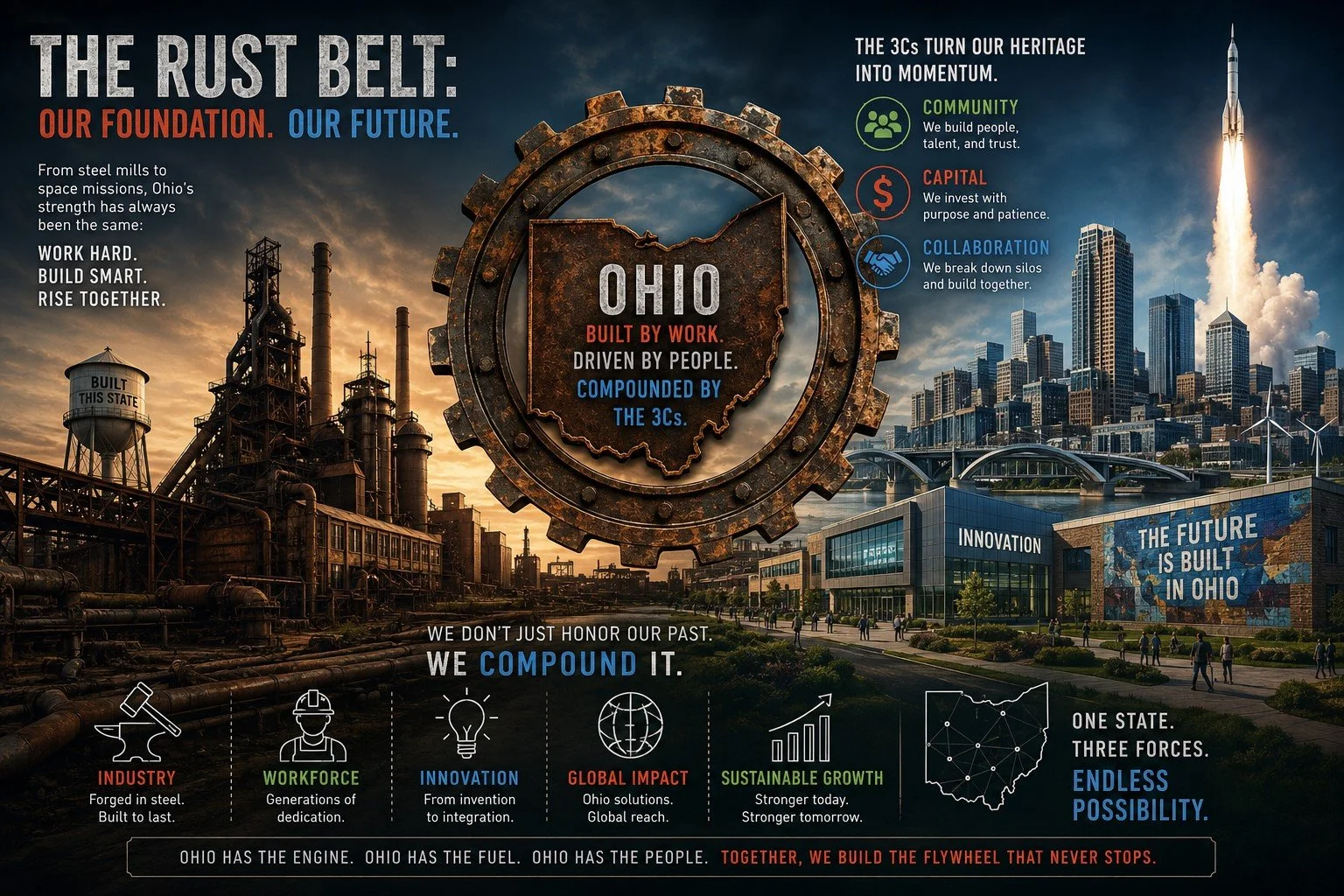
When technology, geopolitics, trade, and innovation are not met with aligned leadership, when Capital stops moving at the speed of disruption, when Community loses its gravitational hold on the talent it trained, and when Collaboration fragments into silos that can no longer respond together, the system doesn’t fail dramatically. It oxidizes. Gradually. Visibly only in retrospect.
Rust is what fills the tolerances when a precision engine goes unmaintained. It doesn’t announce itself. It accumulates in the gaps.
Ohio didn’t earn the name Rust Belt because it lacked mass or gravity. The capital was here. The communities were here. What dissipated was the lubricant, and without it, even the densest, most gravitationally bound system converts its momentum into heat.
3C Momentum
On June 18, 2026, Zachary Mears, Senior Vice President of Strategy at Anduril Industries, stood before a room of Ohio business leaders at an ACG Columbus breakfast and stated the situation plainly. Anduril took the YFQ-44A autonomous fighter jet from clean-sheet design to a fully flying aircraft in 365 days. Arsenal-1, a 5-million-square-foot manufacturing complex in Pickaway County with its first 800,000-square-foot building already operational, is scaling to 4,000 jobs by 2035. And the next five years will be as much a building site as a production site.
“Companies need to prepare for the volume Anduril will drive. Finance structures must generate durability by underwriting ahead of time.” Zachary Mears, SVP Strategy, Anduril Industries, ACG Columbus, June 2026
That is the Rust Belt warning delivered in real time, by a defense company building at commercial velocity on Ohio soil. The window in which supply chain relationships get locked in is open right now. Companies that move at the speed of Anduril’s build phase will be in that supply chain for a decade. Those who wait for the contracts to arrive before preparing their capital structures will find the tolerances already filled.
The question this series has been asking since its first installment is whether the leaders making decisions today are moving at the speed of the disruption in front of them or waiting until the rust is already visible.
Peeyush Shrivastava’s story is evidence that the answer can be yes.
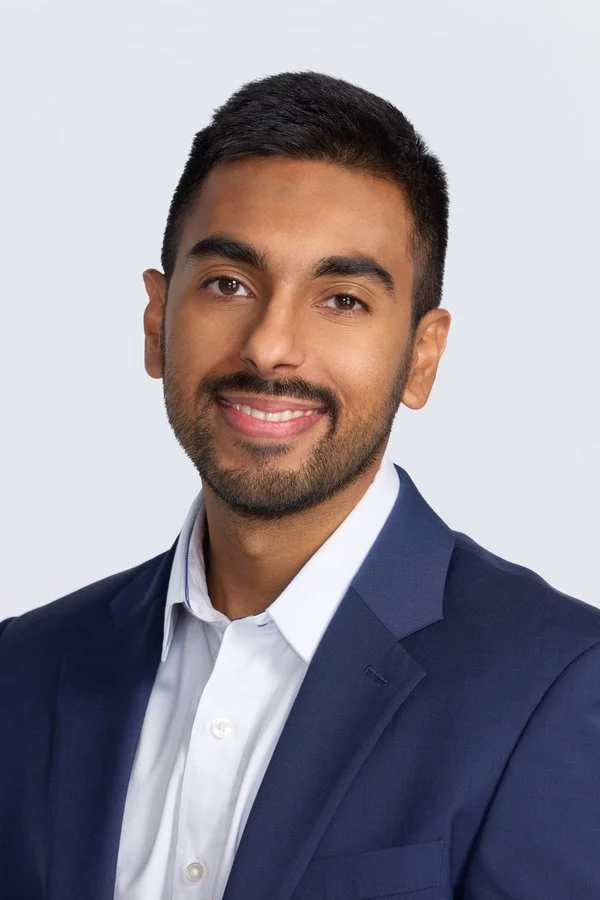
Peeyush Shrivastava (https://theohiofund.com/peeyush-shrivastava/)
Stage One: The Spin-Up
Every flywheel requires an initial energy input. The rotor doesn’t move on its own.
For Peeyush Shrivastava, the spin-up began not in a boardroom or a venture capital office. It began in middle school, when he cold-approached local companies to sponsor his community science fair.
Several of them said yes.
That moment is worth examining closely. A student asks Ohio institutions to invest in something small and local. The institutions respond because the infrastructure for that kind of support was embedded in the community.
In high school, he cold-emailed university labs asking for hands-on cardiovascular research experience. One opened an internship.
At Ohio State, he told his academic advisors he was going to drop out and build a medical device company. They didn’t just sign off.
“They actively encouraged me and rooted for my success.”
This is evidence of a community infrastructure that responds to ambition; founders are supported before their P/E ratio justifies it.
Ask him what it was like to build here, and he reframes the question entirely.
“I grew up in Mason, so the prospect of being able to build in my own backyard was inherently an advantage. I knew the community, the partners, and how and where to access capital, talent, and customers. Sure, it was harder to relocate software engineers and data scientists from the coasts. But our ability to retain talent and give them a great place to work, live, and play is something that is uniquely possible in Ohio.”
That is the gravity argument in founder language. The coasts are pulling, doing their best to recruit the Midwest's best talent. Ohio's community is fighting to keep our talent rooted, and Peeyush's actions are a testament to it being a worthy retention force.
John Horack, Neil Armstrong Chair in Aerospace Policy at Ohio State, frames Ohio's position with the directness of someone who has watched the spin-up across generations: "We are an ascendant part of what it means to be a contributor to the future of the United States." That's not institutional pride. It's a statement about where gravity is concentrated, and where founders who know to look for it will find it waiting.
That is the spin-up. External energy is applied at the right moment to a rotor with the mass to hold it.
Stage Two: The Motor
A flywheel stores energy, yet rotational momentum is never free. Friction converts kinetic energy into heat at a rate the rotor cannot negotiate, and without a motor continuously adding to what friction continuously removes, deceleration is not a risk; it’s a certainty.
Ohio's motor has always been its workforce. Not a single founder. Not a single industry. The people who showed up, built things with precision, and stayed. The golden manufacturing age was built on a workforce that committed to the rotor and kept adding to it, shift after shift, decade after decade. The Rust Belt didn't fail because that workforce quit. The rotor was still willing, and the community was eager to maintain its production.
You don't need to damage an engine to destroy it. You just have to stop putting oil in it.
Short-term capital decisions, made without regard for the system they were drawing from, did what skipping an oil change does to an engine. The block didn't fail dramatically. It seized gradually, heat building in the tolerances, until a system the workforce had spent generations building could no longer turn.
That is the failure mode this series was built to name and avoid as we build forward beyond the rust.
Genetesis is a part of this story, as a cylinder firing in this workforce engine.
Peeyush was 19 years old when he moved to Buffalo after winning the inaugural 43North competition. The prize: $250,000 and a chance to build the company he believed in. He packed eight people into a two-bedroom apartment and went to work.
What he was building was CardioFlux, a non-invasive cardiac imaging technology using magnetocardiography. The premise: detect cardiovascular disease without radiation, without invasive procedures, without the friction that keeps diagnosis out of reach for patients who need it most.
The company raised over $42 million. Investors included Mark Cuban. The FDA cleared key milestones. And Genetesis eventually sold its assets to a major technology company in a quiet exit that validated both the science and the Ohio operating model that the skeptics had spent a decade doubting.
“We dealt with that skepticism the best way we knew how: we put our heads down, built, and proved the skeptics wrong, and the supporters right.”
Not glamorous. Not coastal. Built on grit, the way the Midwest builds. Twelve years of torque applied to the same rotor, until ambition became momentum.
Stage Three: Kinetic Energy Storage
Here is where most Ohio stories leave the ground and disappear beyond the horizon.
The flywheel reaches rotation speed. In aviation, they call it V1: the moment an aircraft has accumulated enough speed that stopping is no longer a safe option. The only direction is forward and up.
Ohio's flywheel hits V1 at the exit. The rotational energy accumulated over years of spin-up is no longer bound by the friction that shaped it. The founder has accumulated enough momentum to be valuable anywhere, and not yet enough tether to remain in the ecosystem that built them. At this velocity, an orbital exit from Ohio is more than a possibility; it’s become a probability.
Coastal gravity doesn't have to be stronger. It merely needs to apply pressure at the right moment.
The rotor doesn't shatter. It lifts off and lands somewhere else. The energy transfers out of state into an ecosystem that applies no resistance to its departure and no structure to recapture it. The flywheel cools. The next founder inherits a rotor bled back toward ambient temperature.
Thermodynamics calls this entropy. Ohio calls it the talent drain. The capital exodus. The brain drain that never quite shows up in the headline, but costs everything in the compound.
What makes Peeyush Shrivastava’s story structurally different isn’t the exit. It’s what happened after it.
He came back.
Not as a philanthropist. Not as a mentor making occasional appearances. As a Principal at The O.H.I.O. Fund, a $647 million evergreen capital vehicle designed explicitly to keep Ohio-generated returns inside Ohio.
That is kinetic energy storage. The momentum that took over a decade and $42 million to build didn’t dissipate when Genetesis closed. It transferred: into capital, into pattern recognition, into a platform with the scale to accelerate the next generation of founders, the way the community science fair donors, the university lab, and the OSU advisors once accelerated him.
Ohio didn’t just support him. It stored the energy he came back with.
The decision to come back wasn’t inevitable. It was chosen. Twice.
“Back in 2016, when my co-founders and I were making the choice to drop out of Ohio State and Case Western, we had to choose where to base our business. The logical contenders were Boston or San Francisco, given their biotech and medtech ecosystems. Then a timely call from Michele Blair in the City of Mason helped us realize how much more we could accomplish, financially and culturally, by building in Ohio.”
That phone call is the community gravity made audible. Someone from Mason reached out. Not a venture capitalist. Not a recruiter. A civic leader who understood what it would mean for her city if those founders stayed. The gravity didn't just exist. It acted.
Ten years later, the same decision presented itself again.
“Now, in 2026, as Ohio inches toward becoming the next trillion-dollar economy, and having seen Genetesis through to its exit, I once again got the chance to decide where to spend my time and energy. Given The O.H.I.O. Fund’s bold vision to invest across the state’s economy using an evergreen model unlike any before it, and the fact that I had worked with Mike Venerable extensively during his CincyTech days, I knew I had to do whatever I could to contribute to the incredible vision of our founding partners: Ray Leach, Mark Kvamme, Mike Venerable, and Jill Meyer.”
The Ohio that called him back in 2026 is not the same Ohio that called him in 2016. It’s larger, faster, and closer to a tipping point than any previous generation of Ohio leaders has seen. The trillion-dollar economy framing isn’t an aspiration. It’s a trajectory that has been building since the first flywheel turned.
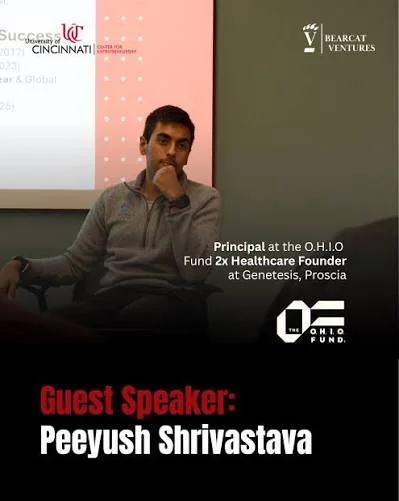
The Fund’s Design
The O.H.I.O. Fund is not a traditional closed-end vehicle. It was built to be evergreen, intentionally structured to invest across time horizons that single-sector funds miss. Infrastructure, real estate, biotech, technology, healthcare, and advanced manufacturing. The multi-asset thesis is not a hedge. It’s a bet on Ohio’s full economic surface area.
By Q1 2026, the results were visible. Total committed capital had grown from $356 million at launch to $647 million. Active deployment reached $217 million across 33 investments. And 155 investors, including Ohio banks, insurance firms, foundations, family offices, and high-net-worth individuals, had signed on to a shared premise: capital generated here should compound here.
The recent investment in LainaHealth, a Dublin-based AI physical therapy platform that eliminates the friction that causes 65% of PT prescriptions to go unfilled nationally, reflects the company's thesis. Ohio-built solutions to real market problems. Scalable nationally. Funded locally.
The relocation of Hyperframe from California to Columbus reflects this at the ecosystem level. A founder scaling a physical product chose Ohio not for the subsidies, but for the manufacturing talent, supplier density, and logistics infrastructure that California couldn’t replicate at the stage the company needed.
That relocation was not accidental. It was what gravity does when it’s strong enough to pull mass across state lines, and when a capital vehicle exists to make the pull visible and accessible.
Anduril is now asking for this at a scale Ohio has never seen. At ACG Columbus on June 18, 2026, Zachary Mears made the supplier regionalization thesis explicit: Anduril wants to replace California-sourced components with suppliers in Ohio, Michigan, Indiana, and Pennsylvania, driving costs down by an order of magnitude while building a supply chain dense enough to sustain Arsenal-1’s production for a decade. Supplier days are already scheduled. Vendor relationships are being opened to Ohio companies. The question Mears asked the room was direct: are Ohio businesses preparing their capital structures for the volume Anduril will drive, or will they arrive after the supply chain relationships are already locked in?
The O.H.I.O. Fund’s evergreen structure, designed to deploy capital across time horizons that single-cycle funds can’t reach, is the institutional answer to exactly that question. It can underwrite ahead of demand. It can fund the preparation that converts Ohio’s manufacturing gravity into a supply chain relationship before the contract exists.
The same dynamic is playing out in commercial space. Starlab, launching in 2029 ahead of the ISS's retirement in 2030, has already sold 55 percent of the research capacity on its first mission. Demand capital committed to Ohio’s orbit before the station is even built. The four-year window between now and ISS decommissioning is the same kind of build-phase window Anduril has opened in defense manufacturing: the supply chain relationships, workforce pipelines, and capital structures established now will determine who participates in the production decade that follows.
Source: https://theohiofundreport.com/
Stage Four: The Friction Problem
The first mile without oil doesn't break the engine.
That's what makes short-term decisions so dangerous. The damage isn't immediate. The temperature climbs gradually. The tolerances tightened by degrees so small they don't register as warning signs until the system is already compromised. By the time the seizure happens, the cause is years behind you, buried in a series of decisions that each looked reasonable in isolation.
The rotor didn't leave. The lubricant did.
Ohio's friction problem is a collaboration problem. Not a capital problem. Not a community problem. The investments are being made. The institutions are present. What isn't being built, consistently and at speed, is the connective infrastructure that lets Capital and Community find each other before the opportunity closes.
Charles Kuehmann framed the lubricant problem as an engineering discipline at the NAE Regional Meeting at Ohio State. His algorithm for getting to space: question every requirement, delete as many as you can. The same discipline applies here. Ohio's collaborative friction isn't only external skepticism. It's also the accumulated institutional requirements, the approval structures, the processes that exist because they always existed, that prevent Capital and Community from reaching each other at commercial velocity. Collaboration as a lubricant means having the organizational courage to delete requirements that serve friction more than they serve outcomes.
Zachary Mears put the same diagnosis in supply chain terms at ACG Columbus. Long lead times aren't a logistics problem. They're a collaboration problem. Ohio manufacturers who haven't built the financial and operational structures to keep pace with demand will find the friction insurmountable when Anduril's volume arrives. The lubricant in that model is pre-competitive preparation: supplier days, vendor access events, capital structures designed to respond at production velocity before the contract exists.
This is what the perception gap measures. Outside capital doesn't undervalue Ohio because the capability isn't here. It undervalues Ohio because the collaborative infrastructure that makes capability legible, the supply chains, the partnerships, and the shared preparation, has not been visible enough to price. The gap isn't a marketing failure. It's a collaboration failure made external.
Anduril's supplier days, the O.H.I.O. Fund's evergreen deployment horizon, the 2026 ACG Ohio Aerospace and Defense Investment Summit: each is an act of applying lubricant to the flywheel motor. Bringing Capital and Community into the same room, at the same time, so the friction has less surface area to tax.
The constraint was never the rotor. It was always the friction and the lubricant that Ohio forgot to apply.

3C Lessons
Stage Five: Full Rotation
The engineering goal of a flywheel is not perpetual motion. It is a stable, self-sustaining rotation in which the energy stored in the system is sufficient to absorb shocks, smooth irregular inputs, and deliver consistent output without requiring a constant external force.
Ohio is not there yet. But the conditions for it are forming simultaneously, across multiple sectors, in a convergence the state has not seen before.
Arsenal-1 is deploying capital against a 10-year conviction, not a contract. Starlab is launching in 2029 with more than half of its first mission already sold. The O.H.I.O. Fund is capturing the returns that previous generations of Ohio founders left on the table. For the first time, all four capital archetypes (strategic foresight, innovation catalyst, industrial ecosystem, and workforce-centered investment) are active in Ohio simultaneously.
That convergence is not coincidental. It is the result of alignment: imperfect, incomplete, but directionally correct, between institutional capital, research infrastructure, industrial legacy, and workforce development systems that have been building toward this moment across decades.
The bearing that holds this rotor in alignment has a name: JobsOhio. One of the most consequential experiments in quasi-private economic development in the United States, JobsOhio operates as the governance mechanism that prevents Ohio’s capital archetypes from grinding against each other. The principle is simple: without governance, collaboration defaults to talent bidding wars. With governance, it becomes a flywheel.
Mark Kvamme, architect of JobsOhio, co-founder of Drive Capital, and lead of The O.H.I.O. Fund, is the same person operating as both the bearing and the motor. That is not a coincidence. It is the series’ thesis made structural: when the leaders who built the governance infrastructure are also the ones deploying the capital, the flywheel’s conditions compound rather than compete.
Peeyush now sees the operating model question from both sides of the cap table. As an investor, he draws his evaluation framework directly from his experience as a founder.
“That’s in large part an assessment of the founder and leadership. Many entrepreneurs in the state have been building their businesses here for many years, or even decades. They have been capital efficient, nimble, and proactive in catching waves. Getting to know their stories, their hardships, and their successes is both inspiring and a great way to evaluate which companies are being built to last.”
Capital efficiency. Nimbleness. Wave-catching. These are not traits that grow in coastal ecosystems optimized for hyper-growth and rapid exits. They are the traits that grow in Ohio, where capital is scarcer, where founders have to make every dollar count, and where the community’s gravity keeps them accountable to something larger than their own return.
Peeyush Shrivastava is the proof of concept. Not because his story is exceptional. Because he insists it isn’t.
“I don’t believe my experience is unique. I’m bullish on Ohio because the support, resources, and encouragement I’ve received as an Ohioan are deeply embedded in our community.”
That’s the flywheel argument in its purest form. The system works. It has always worked. The goal now is to reduce friction enough, add enough mass, and maintain enough rotational speed so that it no longer requires exceptional founders to restart it from scratch.
Ohio’s capital mass is most concentrated today exactly where its economy is most diverse. That is both the asset and the argument.
“Ohio has one of the most diverse economies in the world. Capital investment in our state should reflect that fact.”
That sentence is a pointed critique of the single-sector, single-stage capital strategies that have historically extracted Ohio’s returns without replacing them. The O.H.I.O. Fund’s multi-asset evergreen structure is the direct institutional response. Not a bet on one sector outperforming. A bet on Ohio’s full surface area compounding across all of them simultaneously.
Where the capital is still thin: the supply chain infrastructure that Anduril and Starlab are demanding right now. The aerospace and defense build phase requires manufacturers to prepare their balance sheets before contracts arrive. The commercial space window requires workforce pipelines aligned to a 2029 launch date, not a 2035 federal program. The gap between Ohio’s institutional depth and its capital velocity is the friction point that the next generation of O.H.I.O. Fund investments is positioned to close.
John Horack said it as the VISTA Space Park partnership was taking shape: “We are in the first and early chapters of what will be a long and exciting story of research and innovation. We’re already up and running here.” That’s not a preview. It’s a status report. The engine is running. The mass is building. The gravity is pulling.
When the wheel is spinning at full speed, the next Peeyush Shrivastava doesn’t need a science fair donor to believe in them. The infrastructure already does.
The 3Cs Applied
Capital: The Mass
The denser the rotor, the more energy it holds. Capital is Ohio’s mass: the accumulated weight of investment, infrastructure, and institutional depth that determines how much the flywheel can store and sustain. The recycled equity thesis is simple. If capital generated here compresses back into the rotor rather than escaping as heat, the flywheel gets denser with every cycle. The O.H.I.O. Fund is the first institutional mechanism Ohio has built at real scale to make that compression happen. Anduril’s supply chain ask adds urgency: the mass must be ready before demand arrives, or the opportunity shifts to suppliers in other states that prepared ahead of the demand.
Community: The Gravity
Mass without gravity disperses. The rotor needs a force that pulls inward, that holds capital, talent, and ambition in Ohio’s orbit rather than letting them drift toward coasts where the pull is louder. Community is that gravitational force. The science fair donors. The university lab that opened. The advisors who encouraged the dropout. The City of Mason official who made a timely phone call in 2016. Not programs. Not incentives. Gravity: the embedded, relational infrastructure that draws founders back and keeps capital circulating. Hyperframe relocated from California because the gravity was strong enough to pull it. Arsenal-1’s supplier regionalization thesis is asking Ohio’s manufacturing community to demonstrate the same pull for a supply chain that currently runs through the West Coast.
Collaboration: The Lubricant
Gravity concentrates the mass. Lubricant allows it to move without damaging itself. A flywheel spinning under high friction converts momentum into heat, wasted energy, degraded components, a system that burns through itself before it ever reaches full speed. Collaboration is what removes that resistance. It doesn’t generate force. It doesn’t add mass. It creates the conditions under which Capital and Community can operate at the speed the moment demands without bleeding momentum to friction that serves no one. Anduril’s supplier days are collaboration made structural: a prime contractor building the lubricant into its supply chain model because it understands that without it, the tolerances will widen and the engine will seize before Arsenal-1 reaches full production.
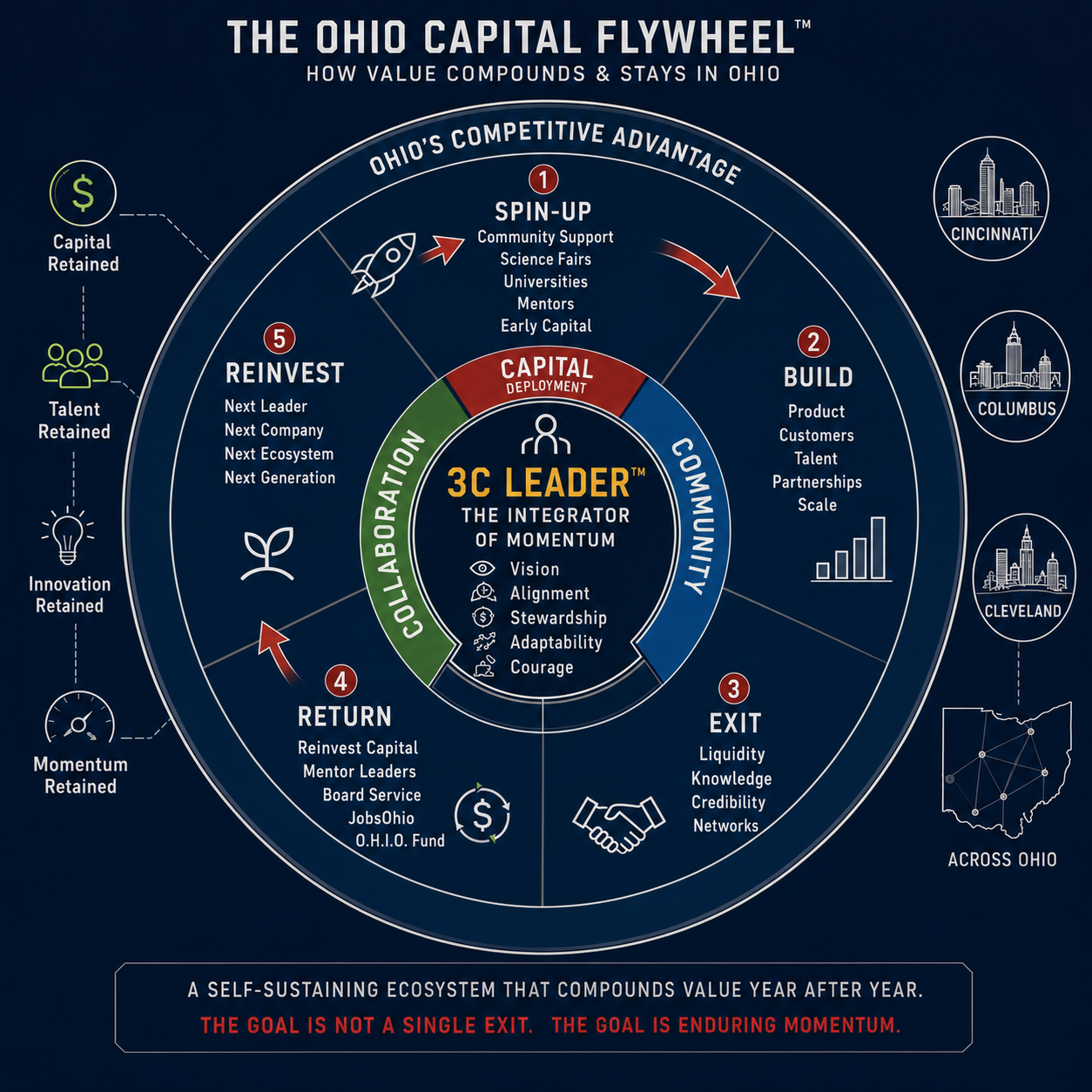
3C Flywheel
The Closing
There is a version of this story in which Peeyush Shrivastava takes his exit, moves somewhere warmer, and allocates capital to the next consumer app.
He didn’t.
He came back to Mason. He joined a fund whose entire reason for existing is the belief that Ohio’s engine has enough mass, enough gravity, and enough collaborative precision to sustain its own rotation, if the conditions are held.
He brings to every investment meeting a question most investors can’t ask from lived experience: what does it actually feel like to build a hard company here, in Ohio, against the skepticism, with the community pulling for you, and what does this ecosystem owe the founders willing to try?
Jonathan Blank, VP of Engineering at GE Aerospace, offered the through-line at the NAE Regional Meeting that runs from physics all the way to this argument. Every problem eventually becomes a materials challenge. And every material challenge eventually becomes a people challenge. The flywheel is a physics metaphor. Its failure mode is always human. The lubricant, the collaboration that keeps the system running, is not a process or a program. It is a decision that leaders make repeatedly in moments when friction is easier than alignment.
On July 4, 2026, the United States turns 250 years old. Much of what made the first 250 years possible was built in Ohio. The Wright Brothers. The jet engine that defined American air power. The first astronaut to walk on the Moon was an Ohioan. The industrial workforce that turned American ambition into a manufactured reality for a century.
The question this generation of Ohio leaders is answering is whether they will do what every previous generation did: build something that compounds for the next 250 years.
The O.H.I.O. Fund is not a commemoration. It is the answer.
Ohio didn’t just build the first plane. We engineered the engine that kept everything that followed airborne.
The fuel is here. The intake is here. The tolerances are precise enough to sustain flight. Ohio has reached V1 before and watched the energy lift off toward someone else's horizon. The difference now is that the infrastructure exists to keep the momentum inside the orbit that built it. The cosmic horizon isn't a coastal destination. It's ours.
From rust comes dust. Dust if you must. In Ohio, we build.
Ohio is best when we choose to build.
Let’s build together.
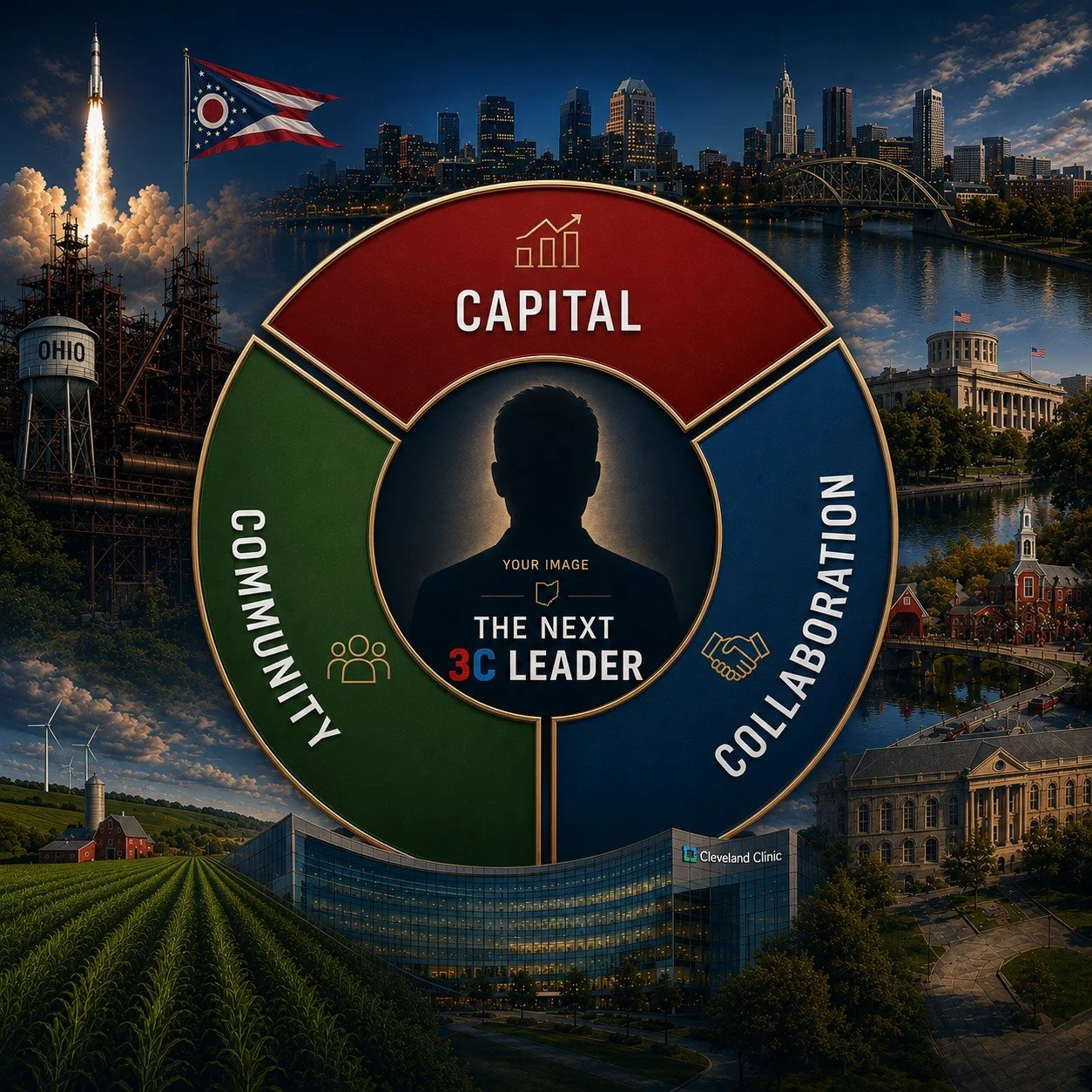
Each installment profiles an Ohio executive whose decisions at the intersection of Capital, Community, and Collaboration are shaping what this state becomes next. If you know a leader whose story belongs in this series, reach out to the author.