

The Founder’s Founder
Andrew Panos built a company over 20 years, sold it, and came back.
“Companies Die When Their Leaders Run Out of Hope.”
Lacey Picazo, CEO of ZoCo, had seen the idea from Pat Carroll and found it striking. It lingered in her head for days.
Then she had coffee with Andrew (Andy) Panos.
Afterward, she declared, “Andy is the spirit of hope.”
That line, from one Columbus founder to another, is the most precise description of what a Founder’s Founder is. It’s not a title, but a quality that sparks admiration and hope. It's about inspiring others to believe in the work, the people, and the city, even after the pressure to prove anything is gone.
Andy Panos has been doing this for more than 20 years in Columbus, actively mentoring founders, investing in startups, and fostering collaboration, which most people in the ecosystem know by name. His ongoing efforts demonstrate his tangible impact, inspiring trust and confidence in the community's future.
The Moment That Became a Mission
The story begins with a moment in a grocery store line in Salt Lake City. Andy Panos is the fifth of seven children. His father had a heart attack at 39 while changing a tire on the side of the road and survived only because a service truck happened to pull up and call 911. The damage to his heart meant he couldn’t work for over a year. The family used SNAP benefits to make ends meet. One summer morning, a young Andy and his brother went to the store to pick up groceries. At the register, a cashier called the manager over, and other customers in line stared. Nobody had seen SNAP benefits before. The family was made to feel different. Isolated. Less than. Andy carried that moment forward for the rest of his life. The conviction it produced is simple and total: no one should ever feel ashamed of who they are. We all have something to offer. We all deserve access to an equal playing field. Then, in the late 1980s, his brother was injured in an accident while traveling in Mexico. The family couldn’t find him, couldn’t reach him, couldn’t get him the care he needed. Not because the care wasn’t available, but because no one in that hospital could bridge the language barrier between a family in crisis and the clinicians trying to help. His brother survived.
Decades later, Lacey Picazo wrote a letter to the healthcare industry explaining why ZoCo was going all-in on health. In it, she described losing her father to curable cancer at age 25. Not because the treatment wasn’t available, but because his medical records didn’t transfer across state lines. Two founders. Two preventable failures. Two moments when a broken system failed someone they loved. Neither of them started a company because they saw a market opportunity. They started because the system failed someone who mattered, and they decided that was unacceptable. That is a different kind of founder who produces a different kind of company.
Andy understood something that day that most people in healthcare had not yet named as a solvable problem: that language access wasn’t a translation issue. It was a patient safety issue. A health equity issue. A structural gap that was harming people every day in hospitals across the country, quietly and without accountability.
He spent the next 20 years building the infrastructure to close it.
The best companies aren’t built from market opportunity. They’re built from moments that make injustice impossible to ignore.
Twenty Years, One Mission
In 2003, Andy founded the Language Access Network, LAN, which would eventually become Martti: the first video remote interpreting platform purpose-built for healthcare. Not a generic translation service adapted for clinical settings. A system designed from the ground up for the stakes, the compliance requirements, and the human complexity of medical care.
Over the next two decades, Martti grew into something the healthcare industry depended on. He co-founded Cloudbreak Health, scaling the mission into a broader telehealth and language access platform. By the time GTCR acquired Cloudbreak, the company supported more than 320 languages and dialects, 18,000 qualified interpreters, and over 800,000 hours of specialized healthcare training annually.
That’s not a product. That’s infrastructure. The health systems built their patient communication models around. The kind that, if it disappeared tomorrow, would leave a gap that nobody could quickly fill.
He is now Founder-in-Residence at Equiti, the parent company continuing the Martti mission, still pushing the frontier of what language access looks like in modern healthcare. His ongoing work serves as an inspiration, demonstrating a deep commitment to community impact and progress.
He could have stopped after the GTCR exit, but that’s not who Andy is.
He didn’t build Martti to sell it. He sold it because the mission had grown bigger than any single structure could hold.
What Makes a Founder’s Founder
In sports, there is a concept called a player’s player: the athlete that other athletes vote as the best, because they see what the stats don’t capture. The preparation. The leadership in the locker room. The willingness to make the people around them better, even at a personal cost.
A Founder’s Founder is the same thing as a player's player in sports: the individual others recognize as the best because they embody leadership, preparation, and the ability to elevate those around them.
It isn’t the person who raised the most capital or got the biggest headline exit. It’s the person that other founders call. The one who shows up in the room not because they need to be there, but because someone else in the room needs them. The one who recycled their experience, not just their capital, back into the ecosystem that produced them.
Lindsay Karas Stencel described Columbus’s capital ecosystem challenge this way: for too long, it operated like a Petri dish. Amoeba eating amoeba. Scarcity thinking. The same insular networks recycling the same limited capital. What Columbus needed was abundance thinking: recycled equity from well-timed exits, experience flowing back in, operators who had built and sold returning not just with capital but with pattern recognition and the willingness to sit on boards and pull the next generation forward.
Andy Panos is that person.
He is bullish on Columbus not as a talking point, but as a living conviction. He grew up here. He built here. He sold here. And he came back. Not because he had to, but because he understands that the next generation of Columbus founders will face the same structural gaps he did, and that someone who has navigated those gaps has an obligation to make the path a little clearer.
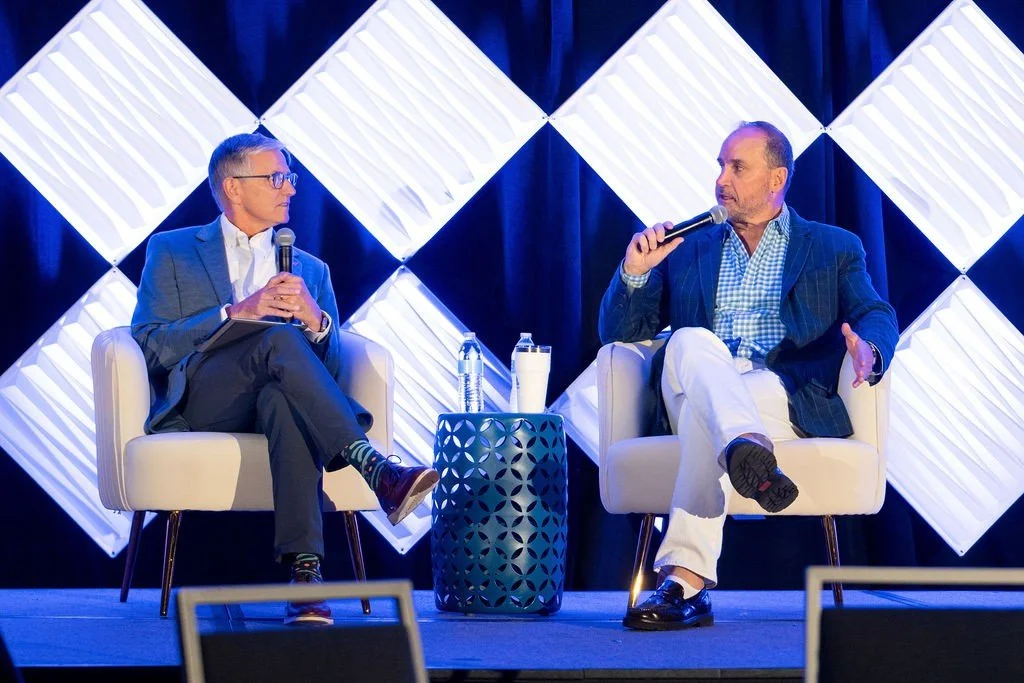
Andy Panos' Keynote Fireside Chat at HCMIS 2024
The Proof: ZoCo and the Spirit of Hope
Lacey Picazo has been building ZoCo since 2013. She spent her career in healthcare long before she started the company, working as an X-ray tech, in her aunt’s home health company, and later in pharmaceutical sales. She knows the industry not from the outside, but from the rooms where it works and where it fails. She lost her father to curable cancer at 25 because his medical records didn’t transfer across state lines. She has navigated Narcolepsy, autoimmune challenges, and misdiagnoses that nearly led to catastrophic decisions. She has lived what she builds for. What ZoCo has become, particularly since its deliberate sharpening into healthcare in late 2024, is not just a UX agency. It is the research and design partner that healthcare product teams trust when the stakes are real.
ZoCo partners with healthcare organizations and companies at every stage, launching new products, improving existing ones, and defining an expansion strategy. The work combines in-depth user research, UX/UI design, and human-centered problem-solving to create experiences that work for patients, clinicians, and the healthcare professionals who rely on them.
The results are documented. Inc. 5000. Webby Awards. Anthem Awards for humanitarian action. Columbus CEO’s number one design studio. Inc. Best Workplaces. Business First Fast 50. ZoCo’s Product Invitational events, invite-only roundtables for healthcare product leaders, have already expanded to Cleveland, Chicago, and San Francisco, with sessions slated in Atlanta and other cities.
Lacey didn’t build ZoCo by waiting for permission or backing. She built it by showing up, year after year, with the conviction that design has the power to create meaningful change in healthcare. That is exactly the kind of founder Andy Panos recognizes.
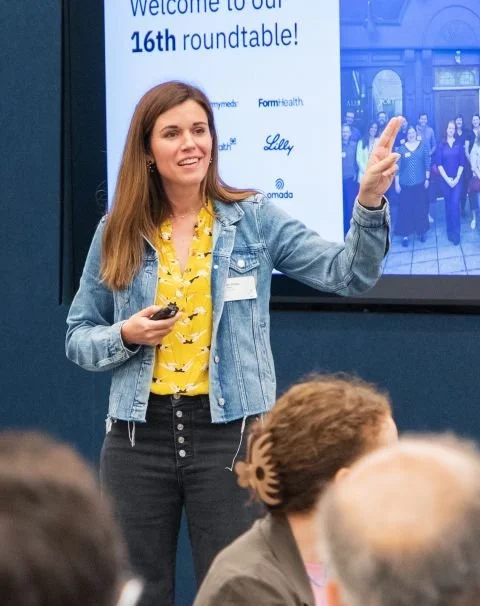
Lacey leading a room full of major healthcare organizations
The Founders’ Pitch
Lacey and Andy first met in 2017 at their Vistage CEO peer group, where they were members together for many years. It’s the kind of private, high-trust room where executives work through real problems with real accountability, where the masks come off, and the real building happens. When they met, Andy had already been through multiple M&A Transactions, taken a company public, and was building at a scale that dwarfed what most founders in that room had attempted.
Lacey was four years into ZoCo, a small and humble consulting agency still finding its footing. And yet Andy sought her feedback. He wanted to be challenged. He wanted opposing points of view, not validation. He treated her perspective as a peer’s, not a mentee’s. That posture, Lacey says, is the energy she wants to be around and to put back out into the world. The relationship became something beyond a founder mentorship.
Andy became a client when he needed UX and healthcare product expertise for Martti; he turned to ZoCo first. He understood the value of technology grounded in human behavior, workflow realities, and the change required to make products actually stick. He didn’t just champion ZoCo publicly. He put his work behind his belief. Vistage is where they built the foundation. What the rest of Columbus gets to see at events like HCMIS is the compound interest on that investment.
To understand why that foundation matters, you must understand what Columbus was building during the decade when both were starting their companies.
In 2008, CoverMyMeds was founded. JobsOhio arrived in 2011. Drive Capital opened in 2013, the same year Lacey founded ZoCo, betting that the Midwest could produce venture-scale returns that coastal firms were missing. Olive and Root Insurance gave Columbus its first nationally recognized unicorn moment.
In 2018, Forbes asked the question directly: Columbus is booming, but will it last? The concern was honest. Most of the growth was still coming from in-migration within Ohio, not from the national and international pull that sustains a truly mature ecosystem. By 2022, TechCrunch was writing about Columbus as the Midwest’s emerging tech hub. By 2025, the Columbus metro had grown to 2.24 million people at double the national growth rate, with 51 percent of that growth now coming from international migration. The Forbes question has been answered.
Lacey pointed out something the data doesn’t capture. In the early days of building ZoCo, she could ask almost any leader in Columbus for coffee and get a real conversation, not a polished performance. Leaders shared where they had fallen on their faces. They showed up as real people rather than the version of themselves they thought the public wanted to see. In some cities, she reflects, leaders keep their challenges behind closed doors. Columbus is not like that. That culture of authentic, unglamorous generosity was the invisible infrastructure beneath every headline about Columbus’s rise. It is what allowed a first-time founder to build ZoCo into something consequential. And it is the culture that Andy Panos has embodied since the day they met in 2017 in a Vistage room: “Happy 10 Years, my Friend.”
Andy and Lacey have been building together for a decade and personally constructing evidence to verify that the Columbus boom is here to stay. When Cloudbreak returned home after multiple trips toward an IPO, the decision was made to become a private company again and to grow in Columbus. Andy shared that story at a ZoCo community event. Lacey posted about it publicly: “He eradicates the healthcare gap caused by language barriers in emergency healthcare settings and built this industry from nothing 20 years ago. I’m proud to call him a friend and a partner of ZoCo.”
Andy offers a different perspective on this town’s success. Columbus has always been a college town between Cleveland and Cincinnati. That perception created something useful, a community of leaders with just enough of a chip on their shoulder to prove how special this city truly is. A pay-it-forward mentality, born from the instinct of a city that had to earn its credibility rather than inherit it. He calls it, for lack of a better comparison, the middle child syndrome. And when he looks at what Lacey is doing, working with major corporations, speaking on national stages, he sees someone carrying the torch for a city and a business community that is leading the next frontier of innovation, entrepreneurship, and growth. AND, he adds, she is absolutely crushing it.
The Founder’s Founder doesn’t just invest in the present generation. He invests in the next one. Andy shows up for more than just established founders. He’s been in the room at the Ohio State Keenan Center for Entrepreneurship’s President's Buckeye Accelerator, sitting with student founders, watching them present, and celebrating when they win.
When he watched Lacey present at HCMIS 2026, at a summit built around the premise that trust precedes transactions, it wasn’t an accidental encounter. I first met Andy at HCMIS 2024, when Lacey introduced us. He was the keynote speaker that year. The introduction was a gift I didn’t fully understand until I watched what happened in that session room two years later. It was the continuation of a relationship that already knew what the other person was made of.
During her presentation, he raised his hand from the audience and asked: " How do you redirect a stakeholder who is certain they already have the right answer? Lacey’s response was poised and precise. You validate their thought first. Then you redirect them toward data-driven validity. You don’t confront the certainty. You give it somewhere better to go. Andy smiled.
Then he turned to the room. “She’s speaking from experience,” he said. There was a time Lacey had to redirect his certainty when he was building. The room laughed.
Lacey smiled the smile of someone who has earned the right to that story. That exchange is the article. Not the credentials, not the exits, not the ecosystem data. Two founders, in a room full of dealmakers, with a decade of trust between them, being honest in public about the work it took to build what they built together. I was in the room when this happened. Watching him see his unsung work solidify into something that had outgrown him in the best possible way. He agreed, after the session, to collaborate on this article. That agreement is itself the proof of concept.
“If companies can die without hope, they can surely thrive when it’s ample.” Lacey Picazo on Andy Panos
Andy watching Lacey's presentation
The 3Cs, Lived Rather Than Argued.
The Leading Across the 3Cs series exists to document a thesis: that Ohio’s competitive future depends not on capital arriving from the outside, but on Capital, Community, and Collaboration compounding from within.
Andy Panos is that thesis, embodied.
Capital: not written as a check, but deployed as credibility, pattern recognition, and the willingness to invest attention in founders whose work deserves a larger stage.
Community: not as a concept, but as a lived commitment. He grew up here, built here, exited here, and returned here. Columbus produced him. He is now producing Columbus.
Collaboration: This article is the evidence. Born in a room at HCMIS 2026, between two people who watched Lacey Picazo present and agreed that the story of what founders do for each other in Columbus deserved to be told.
HCMIS 2026
Access and Logistics
At the National Academy of Engineering Regional Meeting at Ohio State, the convening that helped set the aerospace arc of this series in motion, the closing insight was this: all the challenges we face, on earth and in space, can be boiled down to access and logistics. Sit with that for a moment. Andy Panos spent 20 years solving a language access problem in emergency rooms. Lacey Picazo built ZoCo to solve a behavior logistics problem in healthcare product design. The commercial space station being assembled in Columbus will require solving access to orbit, access to microgravity research, and access to the next generation of human health data. The workforce gaps Ohio faces in aerospace and defense are, at their core, logistics problems: who has the skills, where are they, and how do we connect them to the mission before the window closes. The Leading Across the 3Cs series does not reside in a single sector. It lives in the pattern. Capital, Community, and Collaboration are not healthcare ideas or aerospace ideas. They are the architecture of any solution to any access and logistics challenge worth solving.
Columbus has been built on grit, long before we used the word. Jesse Owens carried a baton for this state on the world's biggest stage. Jack Nicklaus built Muirfield Village and put Columbus, Ohio, on the world stage 50 years ago (with The Memorial Tournament's Golden Anniversary in 2026). My grandfather, Gerry Galloway, once supported a young founder, Jim Grote, in building the first Donato's commissary. Now, Neil Johnson is building rooms; John Horack (The Neil Armstrong Chair in Aerospace Policy and Vice President for Research at Ohio State University) is connecting the next generation of founders to capital through Rev1 while anchoring Ohio's space future at Ohio State; David Williams (Director of Global University and Industry Partnerships for the Starlab/George Washington Carver Science Park at Ohio State, and Emeritus Dean of the College of Engineering) is designing STEM programs that will carry our space industry forward; and Andy Panos is standing by fellow founders like Lacey Picazo. Every generation finds its builders. We are simply the next ones to carry the baton forward.
Ohio is better when we build.
Let's build together.