

A Starlab Is Born
The International Space Station (ISS) will soon be absent from the "Arizona sky". The emerging Star's song - "Oh Me Oh, My Oh, look it's... Ohio!"
Pop culture aside, we're at the precipice of the metaphoric birth of a star. Stars begin as vast molecular clouds, cold, dark, and full of unrealized potential. Gravity pulls pockets of gas and dust inward, slowly at first, then faster. The cloud fragments. A disk forms. Pressure builds. And then, when conditions align, fusion ignites, and what was once empty space becomes a source of light and energy for everything around it.
That's what's happening in Columbus, Ohio. We’re in labor, and our due date is set for 2029 (Starlab's Launch Date).
The Ohio State University is the molecular cloud: Acres of land, decades of research infrastructure, and tens of thousands of students and faculty carrying the raw material of discovery, on its own, immense, yet dispersed.
Voyager is the gravitational force: The commercial engine drawing everything inward, accelerating timelines, concentrating resources, and creating the conditions under which something extraordinary becomes inevitable. Without gravity, a cloud is just a cloud.
VISTA Space Park is the accretion disk: The platform where everything is organized. Where dispersed talent, capital, and research stop drifting and start spinning together in the same direction. The disk doesn't create the star. But without it, there is no star. It is the structure that enables fusion.
And here is the serendipity of it all: the same force pulling the ISS back to Earth is the sole force responsible for the birth of every star; Gravity. As ISS descends on its orbital timeline, the gravitational pull of commercial opportunity is drawing Ohio State, Voyager, and VISTA into alignment. Global capital markets are acting as pockets of gas that coalesce to ignite an era of a commercial space ecosystem.
The ISS didn't fail. It fulfilled its purpose, just as a stellar nursery disperses once its stars are born.
Now the question is whether Ohio is ready to become the light source for what comes next.
Strategic Convergence
As Starlab targets a 2029 launch, Elon Musk has outlined ambitions for orbital data centers powered by scaled-up Starlink satellites. Jeff Bezos has discussed gigawatt-scale space infrastructure as a long-term play. And in November 2025, Google announced Project Suncatcher, a research initiative exploring how constellations of solar-powered satellites equipped with its own TPU chips could scale AI computation in space, with prototype satellites planned for launch as early as 2027. Google's own analysis suggests space-based compute could become cost-competitive with terrestrial data centers by the mid-2030s.
If orbital computing becomes viable, space stations are no longer just research labs. They become service hubs, integration platforms, and materials-innovation engines, supporting a new industrial layer in orbit. This will immediately change Ohio's labor market dynamics.
Orbital data centers will require robotic and human servicing, radiation-hardened materials testing, thermal management innovation in vacuum environments, secure integration platforms for AI and advanced compute, and cross-functional systems engineering between aerospace and data architecture.
Where does terrestrial development connect to orbital execution? At platforms like VISTA, where ground-based testing, materials and manufacturing science, biopharma, AI, robotics, and aerospace manufacturing intersect.
This is why VISTA's tenant diversity matters. When you have AI companies, materials and manufacturing researchers, pharmaceutical developers, and aerospace manufacturers co-located, the workforce needs to be equally multidisciplinary. None of these disciplines exists in isolation.
The ISS Succession Problem
The International Space Station will be decommissioned by 2030, leaving a four-year window to transfer 25+ years of orbital operations expertise, life support systems engineering, microgravity research protocols, and human spaceflight operations.
When the ISS comes down, so does the infrastructure that has enabled continuous human presence in low Earth orbit since 2000, research that has produced breakthroughs in medicine, materials science, and Earth observation, and the operational knowledge required to keep humans alive and productive in space.
That last point deserves emphasis. Tim Kopra's experience as ISS Commander represents institutional knowledge that can't be easily documented or replaced. When he describes operational realities, how crews solve problems, what works versus what's written in procedures, and how teams perform under pressure, that knowledge is built over decades of human spaceflight. It doesn't transfer automatically to the next generation.
Are we capturing ISS operational expertise in educational programs while the people who developed it are still available to teach? Or are we assuming that new commercial teams will figure it out from scratch?
Ohio State, through its partnerships with NASA Glenn, its collaboration with Kopra and other ISS veterans through the VISTA ecosystem, and its terrestrial analog laboratory, could become the institution that preserves and disseminates knowledge of commercial space operations, but only if it moves intentionally and celebrates this work.
The opportunity is not simply to replace the ISS. The goal is to position Ohio within the next industrial stack of space-enabled infrastructure. The partnership between VISTA Space Park, Starlab, and Ohio State University is more than a real estate development. It's a model for how universities, commercial space companies, and capital markets can align to capture generational opportunity.
The Three-Stage Partnership Model
Stage 1: Ohio State University: The Foundation
Ohio State isn't just providing acreage; it's providing academic agriculture. The university provides up to 80 leased acres for the VISTA Space Park development, world-class programs in Biomedical Engineering, Aerospace Engineering, Agricultural and Environmental Sciences, and Materials Science, and a terrestrial analog laboratory, a replica of Starlab that enables parallel ground-based experiments to run alongside orbital research in real time.
The research momentum is already real. PhD candidates are modeling microbial growth from ISS samples. Graduate students are in their third year, advancing space research connected to VISTA. Undergraduate teams are developing experiments for orbital platforms. Ohio graduates more than 13,000 engineers and engineering technicians annually, supported by 100,000 researchers, faculty, staff, and students across the state.
But here's the strategic insight: Ohio State is also a collaboration platform that extends far beyond Ohio. Through existing global university partnerships, it can connect Starlab's operational needs with research institutions worldwide, microgravity effects on cardiac tissue (Cleveland Clinic), stem cell research (Cedars-Sinai Center for Space Medicine Research), and advanced life support systems (international partners). Ohio State becomes the convener, a substrate for global STEM collaboration.
As Professor John Horack, Neil Armstrong Chair in Aerospace Policy, frames it: "We are an ascendant part of what it means to be a contributor to the future of the United States." That's not Ohio pride. That's a strategic positioning statement about where critical space infrastructure knowledge will be concentrated as ISS transitions to commercial platforms.
Students graduating from Ohio State's programs will not be trained solely in theory. They'll have access to facilities, research, and industry partnerships directly tied to operational commercial space stations. The road to low Earth orbit is being built right here, at KOSU on Route 161 within the City loop.
The Ohio State Culture
At The Ohio State University, pride isn't manufactured; it's institutional. Shout "OH" in almost any corner of the country, and "IO" answers back. That call-and-response reflects a living network of leaders, engineers, physicians, and researchers who carry the institution with them long after graduation.
Few leaders embodied that culture more than Emeritus Dean and Professor David B. Williams. A single initiative didn't define his tenure as Dean of Engineering; it was defined by a pattern of institution-building that compounded over time. The creation of The Center for Design and Manufacturing Excellence (CDME) and the Center for Electron Microscopy and Analysis (CEMAS) on the west campus. The growth of the Technology Research Campus (TRC) and The Ohio State University Airport - Don Scott Field (KOSU) has led to deep industry partnerships that translate university research into real economic output. Corporate collaboration deepened. Research scale expanded. The connection between Ohio State and industry strengthened in ways that outlasted any single program or contract. Recently, David and his wife were honored with the naming of the Dave and Margie Williams Auditorium within Mars G. Fontana Laboratories, a tribute not only to academic leadership but to relational leadership.
When I toured the engineering building with Dave, what stood out wasn't the labs. It was the response. Students stopped to greet him. Staff lit up. Administrators leaned in. There was a visible warmth, the kind that can't be mandated, only earned.
Culture, when done right, compounds. It's why companies like Honda of America Manufacturing have long engaged Ohio State talent. It's how biomedical engineers collaborate with Nationwide Children's Hospital and the Wexner Medical Center to support surgical precision through advanced modeling and 3D printing. It's why Ohio State continues to graduate thousands of engineers each year into an ecosystem spanning automotive, aerospace, defense, and healthcare innovation.
But culture only becomes a competitive advantage when it's visible. When I asked Dr. Arun Sharma of Cedars-Sinai's Center for Space Medicine Research where the biggest gaps are between university output and industry-ready skills, his answer was immediate: "Awareness is key, celebrating students and the work that's being done will inspire the next generations."
That's not motivational language. It's a structural observation. Students don't pursue careers they don't know exist. When space medicine research, orbital manufacturing, and commercial space operations aren't visible in university life, high school students planning STEM careers never consider them. Ohio State's terrestrial analog laboratory matters not just as a research facility; it makes space tangible and visible to the students who will build what comes next.
The "OH" and "IO" echoes are authentic. Leaders like Dave and team members like Laura Alvarez, Associate Director for Business Operations and Planning for Starlab and the VISTA Space Park at The Ohio State University, and Abigail Harrison, Starlab Research Lead, Biophysics Doctoral Student, and Biogeochemistry Research Scientist, who happens also to be The Author of Dream Big!, a STEM and Space Communicator, Nonprofit Founder, a Pilot, and earner of the Matthew Isakowitz Fellow 2024, remind us that the strongest institutions are built not just on intellect, but on investment in people and the passions they carry forward.
Stage 2: Voyager Technologies: The Catalyst
Voyager brings a $160 million NASA Space Act Agreement (December 2021) to design Starlab as part of the Commercial LEO Destinations program, and engineering expertise through its joint venture, Starlab Space LLC, with Airbus (formed in January 2024). Strategic partners include Mitsubishi Corporation (an equity owner and major customer), Palantir Technologies (AI and digital twin systems), MDA Space (robotics—developer of Canadarm), Space Applications Services (European systems integration), and Hilton (crew habitat design).
The timeline is firm: Starlab launches in 2029 and is operational before the ISS's retirement in 2030. As of November 2025, 55% of the first mission's research capacity has already been sold. The station deploys via a single SpaceX Starship launch and is fully functional upon arrival; no multi-year assembly is required.
Voyager isn't waiting for government RFPs or multi-year procurement processes. They're building commercial timelines with commercial accountability. Traditional aerospace projects follow 10–15-year development cycles with government oversight at every milestone. The Voyager/Starlab model operates on 5–7-year cycles, with private capital held accountable. That's not just a faster clock; it's a fundamentally different culture that demands a different kind of workforce.
The workforce challenge is more than just speed; it's also judgment
Voyager needs engineers with aerospace rigor and commercial speed. Program managers who understand NASA standards and venture-backed timelines. But beyond credentials, commercial space stations will require something traditional aerospace pipelines rarely train for: autonomous decision-making under pressure.
Tim Kopra put it plainly at the Medicine in Space event: autonomy will be vital to solving problems in space. The “wait for Houston to decide" model doesn't survive a commercial operating environment. Crews and ground teams need to exercise judgment with incomplete information, under time constraints, with high consequences for error. That's a fundamentally different skill set than procedure-following and escalation-based aerospace culture.
The institutions that prepare students for commercial space operations are increasingly important, as traditional aerospace careers are quickly becoming outdated. Technical skills alone will not win the space talent race; they must shape thinking that leads to autonomous, sustainable solutions.
Stage 3: VISTA Space Park: The Platform
VISTA transforms commercial space from a model of a few large companies doing secretive work into an industrial ecosystem where multiple companies collaborate, compete, and share infrastructure. It is, as Voyager's Jeffrey Manber, who helped pioneer the commercial space station model and now leads VISTA, describes it, a proven business model: a place staffed with experts who know how to move an idea from inception to marketplace, where everyone in the ecosystem benefits.
This matters because hardware alone does not create markets: governments fund platforms, modules, and launch systems. But utilization, not construction, will determine whether space infrastructure endures. VISTA is Voyager's answer to that reality: the commercialization engine designed to ensure Starlab and the platforms that follow it are not underleveraged.
It is also the first U.S. science park designed specifically to anchor the emerging in-space economy. There are science parks dedicated to AI, maritime technology, biotechnology, and energy. There has never been one dedicated to commercial in-space research and manufacturing, until now. As Manwei Chan, Director of International and Science Development at Voyager, puts it, there is no science park in the United States dedicated to commercial space research and manufacturing. That is what VISTA is building.
Its lease-based model on up to 80 acres allows more than a dozen current tenants across biopharma, AgTech, AI, semiconductors, robotics, and biomedicine to co-locate and access Ohio State facilities, high-bay laboratory space, testing infrastructure, and academic expertise, without building it themselves. Startups access space-grade facilities without $100M capital raises. Non-traditional industries experiment with space R&D. International partners co-locate without separate infrastructure. Capital markets invest in the ecosystem, not just individual companies.
VISTA also honors its roots. Its evolution from George Washington Carver Science Park carries the legacy of agricultural innovation forward into comprehensive space research, a reminder that breakthrough science has always required patient, sustained investment in foundational infrastructure.
In practice, shared infrastructure means shared workforce development. Starlab, Blue Origin, Anduril, NASA Glenn contractors, and smaller space companies can co-invest in spacecraft technician certification programs, security clearance sponsorship pipelines, advanced manufacturing training, and operations training for commercial space station support. Credentials become portable. Engineers move between organizations without starting from zero. HR professionals recruit from a regional talent pool rather than isolated company pipelines.
When space infrastructure becomes accessible, workforce demand doesn't grow linearly; it multiplies.
The Workforce Multiplication Effect
Orbital computing and space-based manufacturing multiply workforce demand across sectors. AI firms need aerospace-literate engineers. Biopharma companies need microgravity process designers. Semiconductor innovators need radiation-aware materials scientists. Defense-adjacent companies need cleared autonomy specialists.
The materials science opportunity deserves particular attention. Tim Kopra has emphasized that materials science and manufacturing in microgravity is where commercial space will see its most significant breakthrough applications, from pharmaceuticals manufactured in zero-g to semiconductor crystals grown with fewer defects to advanced alloys impossible to create on Earth. This isn't a story about aerospace engineers alone. It's materials scientists, physicists, chemical engineers, pharmaceutical researchers, and manufacturing specialists who understand how to operate in microgravity environments. The commercial space workforce of 2030 looks nothing like the aerospace workforce of 2020.
PitchBook data continues to show sustained capital flowing into dual-use technology, advanced manufacturing, autonomy, and space-adjacent systems across the Midwest. Investors are increasingly underwriting ecosystems, not just individual companies.
Capital compounds when execution risk is low, and execution risk in this moment equals our workforce readiness.
The 3Cs Applied to Convergence
Capital: Beyond Buildings
VISTA represents physical capital deployment. But capital markets are now evaluating workforce infrastructure as part of project risk modeling. Regions that can demonstrate their capacity for clearance pipelines, cross-disciplinary STEM throughput, applied training speed, and retention metrics will attract follow-on investment.
Community: Competitive Quality of Life
Space companies relocate talent. Talent relocates families. Housing, childcare, transit, and international integration policies are not secondary considerations; they are competitive differentiators. If Columbus, Dayton, and Cleveland solve this better than Huntsville or Houston, VISTA becomes sticky. If not, we become a temporary waypoint.
Collaboration: The Governance Question
Pre-competitive workforce collaboration does not happen organically. Someone must convene universities, tenant companies, community colleges, HR leaders, economic development partners, and capital partners around shared infrastructure and shared goals. Without governance, collaboration defaults to talent bidding wars. With governance, it becomes a flywheel.
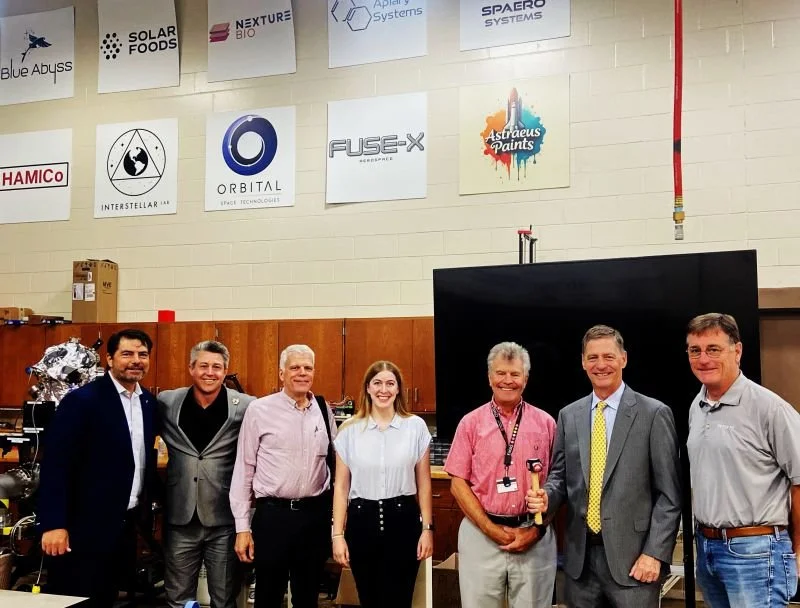
At the meeting that seeded this 3C initiative (pictured above), Lou Von Thaer (Battelle's CEO) is holding a hammer. A symbol gifted to Professor John Horack, the Neil Armstrong Chair in Aerospace Policy at Ohio State, engraved with the intention behind it all: space development for our community. A confirmation, space is no longer abstract. We must make space an everyday tool. The time to "Hammer" is now; what comes next will be built by us.
The Stakes
Alignment is essential. Orbital computing, microgravity manufacturing, and AI-enabled space operations are short-term realities for workforce development. Convergence is underway, and greater awareness is needed. By aligning capital, Community, and collaboration, Ohio can become the operating system for commercial space infrastructure rather than just a participant.
That's what the Leading Across the 3Cs initiative is about. And the decisions that shape it are being made right now.
Call to Action
If you're leading workforce strategy across Ohio's aerospace ecosystem, I want your perspective. Where is collaboration working?
Where is it constrained? What would unlock speed and encourage further alignment?
Ohio's future in commercial space isn't being built in space yet. We must first align our Three Cs to build the workforce infrastructure Ohio needs to support a global space ecosystem.
Let's build it together.